
By Anton Crabbe 20th November 2026
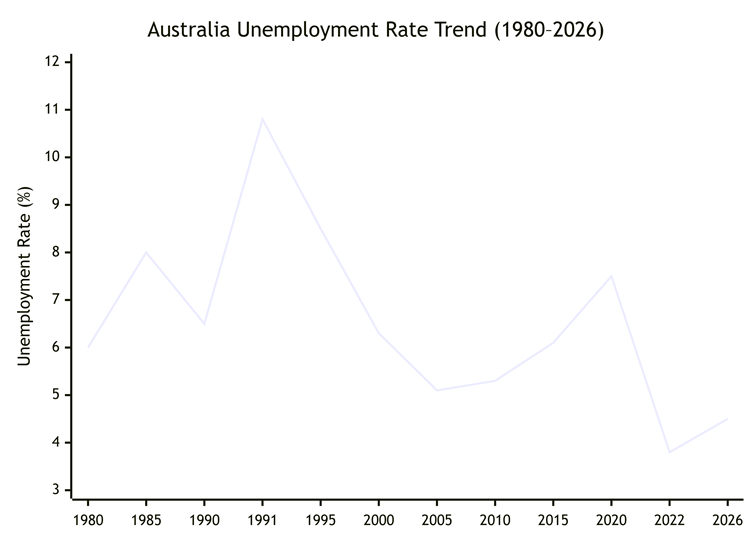
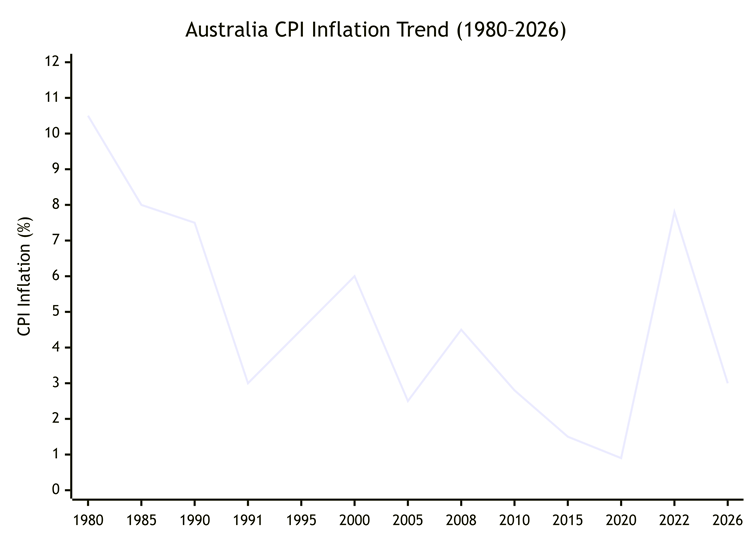
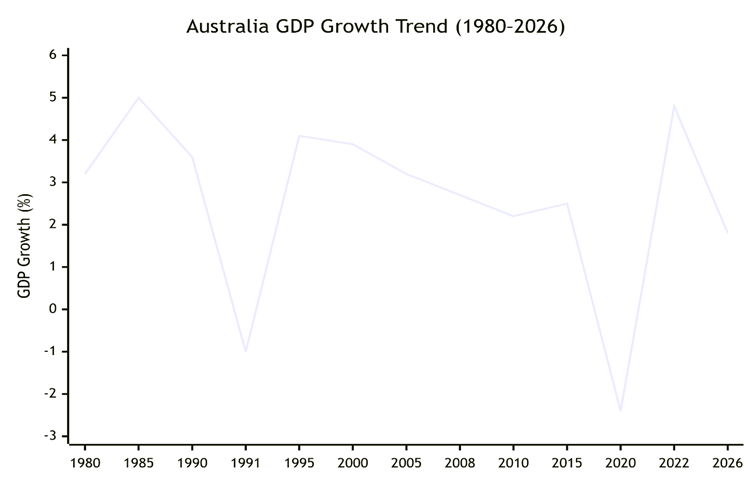
The relationship between inflation, economic growth and unemployment has been a recurring theme throughout Australia’s modern economic history. Looking at the broad trends since 1980, a pattern emerges: when economic growth slows and inflation moderates, unemployment tends to rise (see Graphs 1, 2 and 3). While the future is never certain, current commentary from the RBA suggests Australia is entering a phase where controlling inflation takes precedence over maintaining exceptionally strong employment outcomes.
As I mentioned in my Economic Outlook 2026, the RBA, up until its first meeting in February 2026, had been focused on maintaining the job gains made since COVID while reducing inflation, and had been content with higher inflation in 2025. Given this line of thinking, I expected the RBA to hold rates in February 2026 and anticipated one or two rate increases for the year. However, I also cautioned:
“If they do increase interest rates, I think this will show a change in their thinking and there will be more rate increases in CY26, but as it stands currently I am not expecting more than one or two rate hikes at best in CY26.”
How right this turned out to be! So how did we end up here?
During the post-COVID recovery, policymakers faced a difficult balancing act. The economy rebounded strongly, unemployment fell to multi-decade lows, and labour shortages became widespread. At the same time, inflation accelerated to levels not seen for many years. In response, the RBA embarked on one of the most aggressive interest rate tightening cycles in recent history, with the primary objective of bringing inflation back within its target range.
Historically, higher interest rates work by reducing demand in the economy. Households spend less as mortgage repayments increase, businesses become more cautious about investment, and economic growth slows. While this process helps reduce inflation, it often comes at the cost of a weaker labour market. We are seeing this now in the latest unemployment figures, released on 19th November 2026, where unemployment has risen to 4.9% from its historic low of 3.5% in June 2022.
Previous downturns, particularly the 1991 recession and the 2020 pandemic shock, show a clear pattern: as GDP growth weakened, unemployment increased, while inflation either fell or remained subdued because demand across the economy softened. The relationship is not perfect, but over long periods it has proven remarkably consistent.
Today, there are signs that Australia may be transitioning from an inflation problem to a growth problem. Inflation has already fallen significantly from its peak, while economic growth has moderated. At the same time, governments at both the federal and state levels are increasingly discussing fiscal restraint and budget discipline. If public spending growth slows while monetary policy remains restrictive, overall demand in the economy could weaken further.
In that environment, unemployment becomes the adjustment mechanism.
A softer labour market would reduce wage pressures, helping inflation continue its decline. However, lower employment growth would also weigh on consumer spending, business confidence and overall economic activity. The likely outcome would be:
- Lower CPI inflation
- Slower GDP growth
- Higher unemployment
The critical question is not whether unemployment rises, but by how much. A modest increase would represent a “soft landing”, where inflation returns to target without a recession. A larger increase could signal a more significant economic slowdown.
For investors, homeowners and business owners, the key takeaway is that inflation may no longer be the primary risk. Instead, the focus may gradually shift to economic growth and employment. If the trends of the past forty years continue to hold, Australia’s next economic challenge will be managing slower growth while preventing unemployment from rising too far. The harder question is how to restart an economy burdened by poor productivity, high taxes, high input costs, and excessive rules and regulations.
I think AI will help, but if we are going to get out of this, much of the heavy lifting will need to come from tax and industrial relations reforms by state and federal governments.
In conclusion, the latest rise in unemployment to 4.9% fits a pattern seen throughout Australia’s economic history: as inflation is brought under control, slower growth tends to follow. The RBA’s focus on inflation now looks to be working, based on using the unemployment rate as a leading indicator and looking at historical trends. So, the key risk now is how far the labour market softens. Whether Australia achieves a soft landing will depend less on interest rates and more on improving productivity, lowering costs, taxes and streamlining industrial relations. The hard work is just starting!
Graph 1
Graph 2
Graph 3
Disclaimer: Rational Share Investing With Ratios does not hold an AFSL and information on this site should not be considered financial advice, personal or general, and represents the views of the author.
Reference to specific securities (if any) is included for the purpose of illustration only and should not be construed as a recommendation to buy or sell the same. All securities mentioned herein may or may not form part of my holdings at a certain point in time, and the holdings may change over time.


Leave a Reply