
By Anton Crabbe 20th November 2026
Recent weakness in share markets has understandably made investors nervous. Headlines warning of market volatility, slower economic growth, and softer corporate profits have led many to question whether the bull market is coming to an end. But what if the recent pullback isn’t a sign that something is wrong? What if it is actually a sign that markets are behaving in a normal way?
The Relationship
To understand what is happening today, it helps to step back and look at the bigger picture. Over the last four decades, bond yields and asset prices have moved in opposite directions. From the early 1980s through to 2020, government bond yields experienced one of the longest declines in financial history. During the same period, share markets, property prices, and other financial assets enjoyed an extraordinary boom.
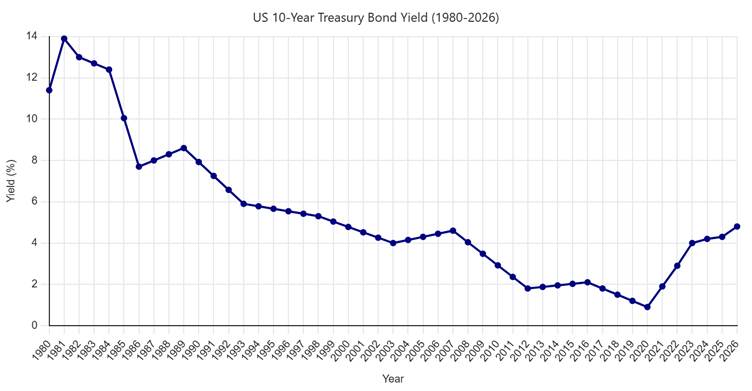
The reason is simple. When bond yields fall, investors are willing to pay more for future earnings because alternative investments offer lower returns. Lower interest rates also reduce borrowing costs and encourage investment throughout the economy. Falling yields became a powerful tailwind for asset prices. Today, that tailwind has changed direction.
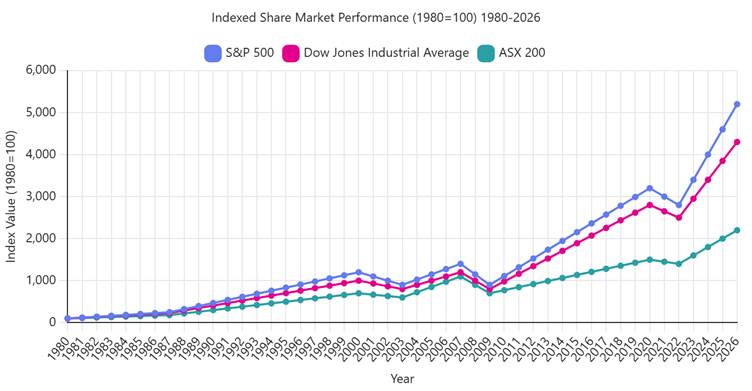
Markets Are Adjusting to a New Reality
Following the post-COVID inflation surge, bond yields moved significantly higher and have remained elevated compared with the ultra-low levels seen during the previous decade. U.S. 10-year Treasury yields are now well above the levels that investors became accustomed to between 2010 and 2020. This matters because higher bond yields change the way investors value shares. When investors can earn 4-5% in relatively safe government bonds, they become less willing to pay extreme prices for future earnings. In short, some repricing becomes necessary. That is exactly what markets appear to be doing.
Why This Pullback Is Rational
Many commentators treat any market decline as a warning sign.
I see it differently. If bond yields have moved higher, it is entirely logical for asset prices to adjust. Markets are not supposed to rise regardless of economic conditions. Healthy markets continuously reassess risks, opportunities, earnings expectations, and interest rates. When those factors change, valuations should change too.
Rather than indicating panic, the recent pullback may be evidence that markets are functioning efficiently. Prices are adjusting to reflect a higher cost of capital and a world where money is no longer free. That is rational behavior.
Morgan Stanley’s Australian Investor Note
Recent commentary from Morgan Stanley points to softer profit growth, weaker domestic economic conditions, slowing consumer demand, and more challenging earnings expectations for Australian companies. Importantly, this does not necessarily mean the economy is heading for disaster.
Instead, it suggests that earnings expectations formed during a period of exceptionally low interest rates may now be too optimistic. Markets are responding by re-evaluating what businesses are worth under a higher-rate environment. Again, this is a rational process.
Why I am Not Concerned
The most dangerous markets are often those where prices rise far beyond underlying fundamentals. Corrections help prevent that outcome.
They remove speculation, improve valuations, reset expectations, and create a healthier foundation for future returns. In many cases, a moderate pullback can be viewed as the market taking its medicine early rather than allowing imbalances to grow into a much larger problem later. For long-term investors, that is a positive development. I would be more concerned if markets kept moving higher, given where current bond yields sit.
The Share Nuffy View
The recent pullback should not automatically be interpreted as a sign of weakness. Instead, it may represent a market adapting to a world of higher bond yields, more realistic profit expectations, and a higher cost of capital. That adjustment is not irrational. It is exactly what investors should expect. After decades of falling interest rates boosting asset values, markets are being forced to stand on a different foundation and value assets with a higher cost of capital and risk-free rate of return. Sometimes the healthiest thing a market can do is stop running ahead of reality.
Disclaimer: Rational Share Investing With Ratios does not hold an AFSL and information on this site should not be considered financial advice, personal or general, and represents the views of the author.
Reference to specific securities (if any) is included for the purpose of illustration only and should not be construed as a recommendation to buy or sell the same. All securities mentioned herein may or may not form part of my holdings at a certain point in time, and the holdings may change over time.


Leave a Reply